The 1950s
The Golden Age of Broadway


The 1950s were a time of immense change and powerful contrast. Postwar prosperity brought economic growth, suburban expansion, and a rising middle class, while Cold War tensions fueled anxiety and suspicion. At the same time, the cultural landscape began shifting, as rock and roll exploded, television became a household staple, and a new focus on the younger generation began to reshape entertainment. Rebellion, innovation, and a hunger for self-expression defined the decade.
Amid all this transformation, Broadway found itself at a crossroads. With competition from movies and television, the stage had to evolve to stay relevant. Some shows leaned into tradition with dazzling spectacles and familiar stories, while others pushed creative and thematic boundaries. The decade produced both record-breaking hits and high-profile flops, revealing the changing tastes of American audiences.
Broadway’s most successful shows had strong storytelling and highly appealed to the changing tastes of a postwar American audience. Audiences of the 1950s experienced a shift to musicals to those that blended multiple genres such as romance and comedy. New-wave musicals featured a distinct narrative in which all of its elements, music, character, and design, were blended together. Notable musicals included: Gypsy, about a vaudeville performer and her daughter; West Side Story, the retelling of Romeo and Juliet set against West Side gangs; and The Sound of Music, based on the story of the Austrian Von Trapps.
“The musical of the 1950s demanded, first of all, a strong narrative-a story with a beginning and a middle and an end, in which subplots and peripheral or irrelevant incidents and characters were kept to a minimum” (Gänzl and Findlay, 2022).
Musicals could no longer rely solely on flashy numbers and campy dialogue. As audiences grew more sophisticated and the competition in media increased, they expected Broadway musicals to deliver compelling and fulfilling stories. This nuanced phenomenon became known as the “book musical” for which Rodgers and Hammerstein (a team of composers) were credited as the pioneers of. “Book musicals” are a show in which the music tells and advances the story. Shows that lacked strong plots were dismissed as outdated or forgettable.
This evolution in storytelling led to some of the most commercially prosperous productions in Broadway history. The popularity of such musicals is reflected in their long-running performances and enduring legacies.
“During the Golden Age, twenty musicals enjoyed initial Broadway runs exceeding one thousand performances, previously unprecedented except for two revues in the late 1930s” ( H. Kowalke, 2013).
The sheer number of long-running musicals in the 1950s reveals how deeply audiences connected with the productions. This success was not accidental, but rather, it reflects Broadway’s ability to adapt to cultural demands and create musicals that are both emotionally engaging and commercially viable.


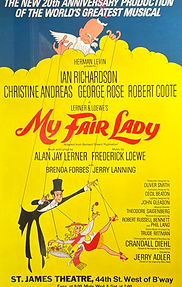
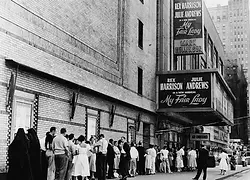
As one of the most successful musicals of the 1950s, My Fair Lady stood out for its artistic innovation, dominating both critical and commercial spaces. It was based on Pygmalion, the George Bernard Shaw play, In the early 1950’s Rodgers and Hammerstein unsuccessfully attempted to turn it into a musical. Years later, Alan Lerner and Frederick Lowe took on the challenge.
Rather than forcing music into the narrative, they allowed the emotional structure and pace of Shaw’s play to form the score. They balanced wit, strong character development, and their lyrics to create a piece that honored its source material while simultaneously enhancing it.
Lerner and Loewe’s adaptation of Pygmalion not only proved that the play could work as a musical, but also resulted in “the most celebrated Broadway musical success of the 1950s and the first work to supplant Oklahoma! as the longest-running musical in the history of the American stage” (Stempel, 1992). By overtaking Oklahoma!, Lerner and Loewe’s work furthered the idea that musicals rooted in rich source material and multi-faceted characters could achieve both mass appeal and critical acclaim.
The show’s triumph was not just on stage, it was also in its promotion. The release of the original Broadway cast recording played a pivotal role in the show’s widespread popularity. The original cast recording was captured in a singular shot in 1956, and was strategically used to market the show’s immediate success. Involving the entire cast and orchestra, the session was documented within a New York Times article, and not only preserved the production but also proved that Broadway cast albums could appeal to a wider audience.





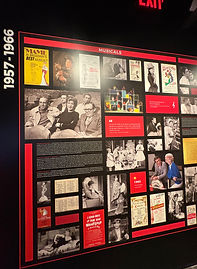
The Museum of Broadway
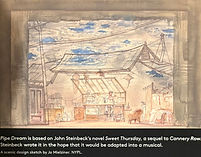
Pipe Dream, on the other hand, represented a bold attempt to bring John Steinbeck’s unconventional novel, Sweet Thursday, to the Broadway stage. It faltered due to its failure to address the themes of its source material. Steinbeck's novel portrayed the lives of marginalized individuals in Monterey, California, focusing on the complex relationship between a marine biologist and a prostitute.
Rodgers and Hammerstein faced challenges in adapting the material for the stage but ultimately developed Pipe Dream. It was an attempt to capture the essence of Steinbeck's characters while adhering to Broadway's conventional standards. However, the adaptation was criticized for sanitizing the darker, more unconventional aspects of Steinbeck's source material.
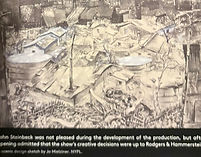
Pipe Dream ultimately suffered from poor casting, a weak script, and a tone that clashed with the original story. Steinbeck was disappointed with the production, and during its Boston tryout he, “felt it was largely due to the show’s more or less conventional handling of an unconventional story. Saving the show, he argued, meant facing an uncharacteristic failure of nerve on its authors’ part and reworking the book to bring it closer to the unpleasant and sexually explicit truths of its source. ‘The show side-steps, hesitates, mishmashes and never faces its theme,’ he wrote to Hammerstein” (Stempel, 1992).
The play was a monumental flop and “When Pipe Dream moved to New York, the price came to include the largest financial loss of any of the nine Rodgers and Hammerstein shows,” despite running for over 200 performances, “and no subsequent artistic reworking, commercial revival, or critical reassessment of Pipe Dream has since vindicated the show” (Stempel, 1992).